Alphorn plays in Seattle Opera's DAPHNE IN CONCERT
by Gary Martin, updated February 2, 2026 (original post: January 26, 2026)
| In Seattle Opera's two concert performances of Richard Strauss's opera Daphne at McCaw Hall on January 16 and 18, 2026, an alphorn was used to play a series of short announcement calls at the beginning of the opera. The alphorn and tuning hand tubes were provided by Edmonds, WA alphorn enthusiast Gary Martin. Gary's role during the performances was to assist Mark in changing the hand tubes. |
In the score for his opera Daphne, Strauss included 5 calls specifically designated for Alphorn. Since the calls are set for rarely used alphorn tunings — G, A-Flat and A — these passages are generally reassigned to trombone or Wagner tuba.
By employing separate tuning tubes (hand tubes) for the 3 tunings found in the score, Associate Principal Horn of the Seattle Symphony Orchestra, Mark Robbins, was able to play all 5 calls on an alphorn (three in G, one in A-Flat, one in A). Research indicates this may have been the first time in the history of Daphne performances that an alphornist played all 5 calls. On occasion, the first 3 calls in G have been played on an alphorn, but I am not aware that the calls in A-flat and A have also been played on an alphorn.
Reviews mentioning the Alphorn (Alpenhorn) in Seattle Opera's performances
Review: DAPHNE IN CONCERT at McCaw Hall /
Apollo’s Sun Shines on Strauss Daphne. / By: Erica Miner / Jan. 20, 2026
https://www.broadwayworld.com/seattle/article/Review-DAPHNE-IN-CONCERT-at-McCaw-Hall-20260120
"The musicians performed magnificently, highlighted by sweetly played violin and cello solos and the use of a real Alpenhorn to add authenticity."
Note: The alphorn and alphornist can be seen in the back, right section of the orchestra in the photo near the end of the article ("David Afkham, Orchestra").
Parterre box / opera from a certain point of view
PERFORMANCE REVIEW
Look to your laurels
A Strauss rarity receives a ravishing concert performance at Seattle Opera.
By Lisa Hirsch / January 24, 2026
https://parterre.com/2026/01/24/look-to-your-laurels/?utm_campaign=shareaholic&utm_medium=copy_link&utm_source=bookmark
"David Afkham has experience in Strauss. Conducting Daphne for the first time, he led a gorgeously transparent and sweeping performance. With the orchestra on stage, behind the principals and chorus, he kept every moment in perfect balance, supporting the singers and never swamping them, even in the biggest orchestral outbursts.
"Members of the Seattle Symphony provide the orchestra of the Seattle Opera, and they played marvelously. Mark Robbins, Associate Principal Horn of the Symphony, took on the alphorn part, prominent in the opera’s opening, then not heard again. Concertmaster Emerson Millar provided a number of beautiful violin solos. Ben Hausmann on oboe and Benjamin Lulich on clarinet played wonderfully, their lines intertwining with those of McGill’s flute throughout."
-----
On January 28, 2026, Lisa Hirsch posted additional comments on her Classical Music Blog:
Iron
Tongue of Midnight
Daphne at Seattle Opera
https://irontongue.blogspot.com/2026/01/daphne-at-seattle-opera.html
"From the second tier, I could see the alphorn that plays a role in the opening of the opera very clearly. It must have been about eight feet long and was very impressive indeed."
----
My comment on this blog post:
"Gary Martin said...
Thank you Lisa for the update. I am the one who provided the alphorn for the Daphne performances at Seattle Opera. There were actually 3 different lengths of the alphorn. Strauss wrote the alphorn calls for Alphorn in G, A-flat, and A! These different tunings were accomplished by changing the top tube (hand tube) of the alphorn (which is made with 3 tubes). The overall length of the alphorn in G is a little under 11 ft (~3.3 m), the alphorn in A-flat just over 10 ft (~3.1 m), the alphorn in A about 9-1/2 ft (~2.9 m). I assisted the alphornist Mark Robbins in changing the hand tubes at the appropriate places in the score. I think the [this] was the first time in the history of Daphne productions that all of the alphorn calls in the score were played on a real alphorn."
January 29, 2026 at 8:03:00 AM PST
---
For additional comments, see the blog post at the link above.
The use of an alphorn in Seattle Opera's Daphne was reported in a Seattle Opera Blog post by Jonathan Dean on Monday, January 12, 2026. See:
Five Reasons to Hear Daphne in Concert
https://www.seattleoperablog.com/
"From the opening duet for oboe and basset horn, which (along with the alphorn) introduce Daphne’s “bucolic tragedy;” to the wild dances for the Feast of Dionysus midway through; to astonishing musical images of sunrise, sunset, moonlight, and the play of light and breeze on the transformed Daphne’s branches, twigs, and leaves, Daphne is a spectacular story-told-by-orchestra."
In the online Encore Program (Seattle Opera, Jan 15, 2026) for "Daphne in Concert," among the Orchestra members is:
Alphorn
Mark Robbins
https://www.encoreplus.app/seattleopera/daphne-in-concert-2026-sop/#orchestra
Generative AI Output
Google AI Overview (Google, 28 January 2026).
Search string: seattle opera daphne "alphorn" alpenhorn
In its January 2026 concert production of Richard Strauss's Daphne at McCaw Hall, the Seattle Opera featured the rarely heard alphorn (or alpenhorn) as part of the orchestra's instrumentation.
- Role in the Opera: The alphorn is used in the opening of this "bucolic tragedy" to create a pastoral atmosphere, calling the people of the region to the feast of Dionysus.
- Performance Detail: Mark Robbins, Associate Principal Horn of the Seattle Symphony, played the prominent alphorn part in the Seattle Opera’s 2026 performance.
- Instrumentation: The score calls for this wooden, mountain-herdsman instrument to evoke the natural world, often paired with woodwinds.
- Performance Dates: The concert performances, which featured Seattle Symphony members, took place on January 16 and 18, 2026.
Daphne is one of Strauss's later, highly orchestrated works, known for its lush, pastoral soundscape.
Earlier Use of the Alphorn in Daphne
An alphorn was used for the initial calls in G tuning (but not the calls in A-Flat or A) in the American Symphony Orchestra's concert performance of Daphne on March 23, 2023 at Carnegie Hall.
Strauss Rarity ‘Daphne’ Gets A Ringing Revival, Beautiful And Very Loud /
By David Shengold, March 27, 2023
https://classicalvoiceamerica.org/2023/03/27/strauss-rarity-daphne-gets-a-ringing-revival-beautiful-and-very-loud/
"The brass and violins handled their duties notably well, and it’s always a kick to see and hear an alphorn."
Chad Yarbrough played the Alphorn in this concert performance.
See the Program notes under "American Symphony Orchestra" (pg. 17 of the pdf file).
Link to the Program notes
(pdf)
Carlo Torlontano has played the Alphorn calls in Daphne in several performances:
https://concertisticlassica.com/en/carlo-torlontano/
"He was the first interpreter of the original part written by Richard Strauss for the opening scene of his “Daphné” which he thus performed at the Gothenburg Opera, the Basel Theater and the Berlin Philharmonic."
See also:
https://sofiaphilharmonic.com/en/artists/carlo-torlontano/
I do not know the dates of the concerts or if all 5 alphorn calls were played on an alphorn.
A New Tork Times review of the Cleveland Orchestra performance on July 15, 2015 mentions an alphorn:
"A distant alphorn call summons the people of this region to a celebration for Dionysus."
It is not clear from this that an actual alphorn was played. It was a distant "alphorn call." It would be helpful to see the program notes with orchestration details.
The Alphorn & Tuning Tubes in Daphne at Seattle Opera
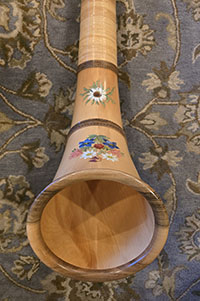
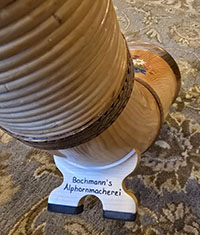
Gary's alphorn was hand-made in Switzerland by Walter Bachmann of Eggiwil (in the upper Emmental, roughly 20 miles east of Bern), where alphorns have been made for over 100 years — since 1925. See: https://www.alphornmacherei.ch/. The A-Flat hand tube was also made by Walter Bachmann. Gary made the hand tubes for G and A tuning, as well as the wooden alphorn mouthpiece to meet Mark's specifications. Today, the most common alphorn tunings are F-Sharp (in Switzerland) and F (outside of Switzerland).
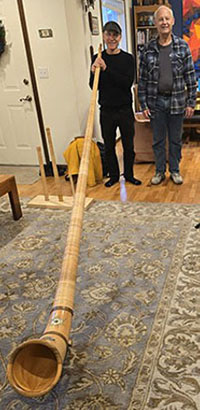
When put together, the alphorn in G is a little under 11 feet long (~3.3 m), the alphorn in Ab is just over 10 feet long (~3.1 m), the alphorn in A is about 9-1/2 feet long (~2.9 m). An alphorn in F is about 12 feet long (~3.6 m).
Mark Robbins (left)
practicing
in Gary's home |
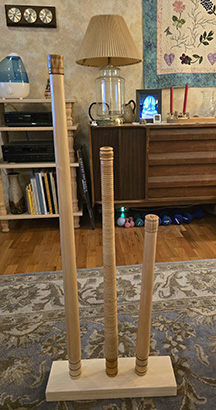
3 Tuning Tubs for Daphne
Left to right: G, Ab, A |
The Alphorn Calls in the Score of Daphne
The score specifies "Alphorn" for 5 calls. However, in the score they are written an octave lower than any normal alphorn can play. As written, an alphorn would need to be twice as long as the lengths indicated above, completely unwieldy! This is most likely an example of "old notation bass clef":
https://www.hornmatters.com/2009/10/why-old-notation/
Why do we have Old Notation Bass Clef? by John Ericson, Oct 10, 2009
"In horn writing there are two systems for bass clef. Composers as late as Shostakovich used what we commonly refer to today as old notation bass clef. In this system bass clef notes are written one octave lower than the octave we play it in. The first time I saw this I recall being very confused, I thought maybe it was notated in C? But no, it was just notated an octave lower than I was to play in the same key as the horn part (horn in F, horn in D, etc.).
New notation has the part written out in the correct octave; you play it as written. Examples of this are quite uncommon before the 20th century."
See also the article by Bruce Hembd, Aug 26, 2008:
https://www.hornmatters.com/2008/08/transposition-tricks-old-vs-new-notation/
Recordings of these Alphorn calls in Daphne
When an alphorn is unavailable to play the calls in Daphne, they are generally played by a trombone or Wagner Tuba in the lower octave, as one observes in the vast majority of YouTube videos.
1. One video has the calls in G played in the upper octave, but no alphorn is shown.
The calls in A-Flat and A are played in the lower octave. Link to video.
Call 1 in G, 3:35-3:45, Call 2 in G, 3:55-4:02, Call 3 in G, 4:37-4:42 - all 3 in the upper octave.
Call
4 in A-Flat, 6:00-6:05, Call 5 in A, 6:53-6:58 - both in the lower octave.
2. One video shows an alphorn player with a short alphorn; the sound is in the lower octave(!). Here the alphorn was used as stage prop. Link to video.
Alphorn Tubes in General
Alphorns today are generally made in 3 sections: The hand tube (closest to the mouth), the middle tube, and the bell section. They are connected together with gold-anodized aluminum couplings supplied with O-Rings to ensure an airtight connection between the tubes. When assembled, the connections between the tubes are mostly hidden, so they appear to be made of a single, long piece. When we play our alphorns in public, the most common question is: "How do you transport such a long instrument?!" A 12-foot long alphorn in F consists of three roughly 4-foot sections.
Like a bugle, an alphorn has no valves, finger holes or slides. The notes playable on an alphorn are restricted to the "harmonic series" based on a "fundamental" pitch that is determined by the overall length of the horn. The longer the alphorn, the lower the pitch of the fundamental. An alphorn in G is longer than an alphorn in A-Flat, which itself is longer than an alphorn in A. The difference in the lengths of the hand tubes shown above was determined by the overall alphorn length needed to achieve the desired fundamental.
The overall length of an alphorn — its pitch or tuning — is thus most easily changed by replacing the hand tube with one of a different length. This can be done quickly — within a few seconds. The alphorn calls in Daphne are sufficiently far enough apart in time that the hand tube can be changed between the calls. Without using replaceable hand tubes of different lengths, the three calls in G, A-Flat and A would have required three separate alphorns!
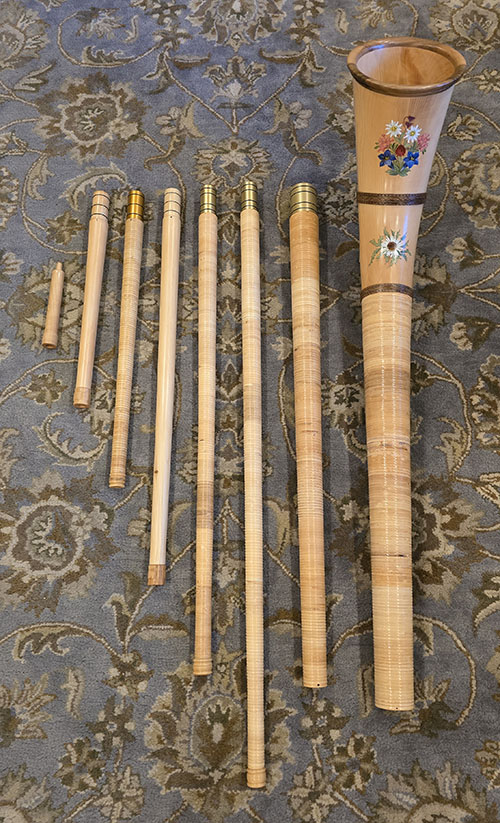
Below: Gary's full (current) set of alphorn tubes.
Left to right:
- 1/2 tone adapter for F# to F, made by Gary
- A tube, made by Gary from Engelmann Spruce
- A-Flat tube, made by Walter Bachmann
- G tube, made by Gary from Gorman Elite ESLP (Engelmann Spruce/Logpole Pine)
- F-Sharp tube, made by Walter Bachmann (included in original alphorn purchase)
- F tube, made by Walter Bachmann (included in original alphorn purchase)
- Middle tube, used in all tunings, connects the bell section to the hand tubes.
- Bell section
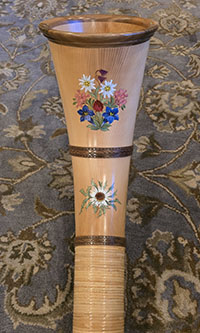
Bachmann Bell with paintings by a Swiss artist in the Emmental:
For more information about Alphorn Tuning Tubes,
see: https://alphorns.com/alphorntubes.html
For a summary of Gary's journey building the tubes for Daphne,
see:
https://alphorns.com/tubemaking.html |