Alphorn Tuning Tubes / Hand Tubes
Alphorn Tubes
Alphorns today are generally made in 3 sections: The hand tube (closest to the mouth), the middle tube, and the bell section. They are connected together with gold-anodized aluminum couplings supplied with O-Rings to ensure an airtight connection between the tubes. When assembled, the connections between the tubes are mostly hidden, so they appear to be made of a single, long piece. When we play our alphorns in public, the most common question is: "How do you transport such a long instrument?!" A 12-foot long alphorn in F consists of three roughly 4-foot sections.
The overall length of an alphorn —i.e. its pitch or tuning — is most easily changed by replacing the hand tube with one of a different length.
Alphorn Tunings: F# and F
The two most common tunings for alphorns today are F-sharp (Fis) in Switzerland and F almost everywhere outside Switzerland.
The historical reason for the F-sharp alphorn tuning in Switzerland today is not completely understood. A likely scenario is that the F-sharp tuning was not crafted with that specific tuning in mind. Before the mid-20th century, alphorns were played by individuals, not in groups. There was no need to standardize a particular tuning. There is a wide range of historical alphorn lengths. In the course of alphorn development, a particular template was used by several alphorn makers. Now that alphorns of the same length were available, polyphonic alphorn playing became possible.
For detailed information about historical alphorn lengths, see:
“The Swiss Alphorn: Transformations of Form, Length and Modes of Playing”
March 2020, The Galpin Society Journal 73:65–84
Authors:
Yannick Wey, Bern University of Applied Sciences and Andrea Kammermann, Lucerne University of Applied Sciences and Arts
ResearchGate Link
Other Alphorn Tunings:
Alphorns in A-Flat
During my research on the central Switzerland mutli-instrumentalist and alphorn player/composer Johann Aregger, I learned during the 1970s and 1980s in Engelberg and the Canton of Obwalden, the standard alphorn tuning was A-flat (shorter than F and Fis alphorns). The general Swiss standard of F# tuning emerged about this time as well.
Es fällt auf, dass im Obwaldnerland fast ausschliesslich mit As-Hörnern geblasen wird.
[It is noteworthy that in the Obwalden region A-flat alphorns are almost exclusively played.]Source: 75 Jahre Zentralschweizer Jodlerverband 1922–1997, Zentralschweizerischer Jodlerverband (ZSJV) 1997, p. 142.
Alphorn songs recorded on LP vinyl records in the 1970s performed by Johann Aregger and his Alphornquartett Titlis are all in A-flat tuning.
In the interest of playing in the same tuning as Johann Aregger and his Alphornquartett Titlis, in August 2025 I acquired an A-flat tuning tube from the maker of my F/F# alphorn, Walter Bachmann (see below).
Alphorns in E
In the Alphorngruppe Uster, Switzerland (Web site: https://www.alphorngruppe-uster.ch/), alphorns today are generally in E (so longer than F alphorns), though F-sharp alphorns are also played. Uster lies about 22 km (14 mi.) east of Zurich.
1963: Gründung der Alphornbläser Uster durch Hans Gehriger
Die Hörner in der Gruppe stammen von verschiedenen Alphornbauern. In Uster werden seit jeher E- und Fis-Hörner gespielt.
[Alphorns in the group come from different alphorn makers. In Uster E- and F# alphorns have been played since the group began.]
1973: 10 Jahre Alphornbläser Uster
1978 schaffen sich das Trio Tännberg, das Duo Schneibel und andere neue wunderbare E-Hörner von Hans Kropf an. In der Gruppe werden mehrheitlich E-Hörner geblasen, jedoch sind an der Probe jeweils auch Fis-Horn-Bläser zu berücksichtigen, was nicht immer einfach ist.
[In 1978, the Trio Tännberg, the Duo Schneibel and others acquire new wonderful E-alphorns from Hans Kropf. In the group, the majority are E-alphorns, but F-sharp alphorn players must also be taken into account at rehearsals, which is not always easy.]
Source: "Die Alphornbläser Uster: Geschichte und Ereignisse" in "Die Alphornbläser Uster 1963-2013.pdf," downloaded from:
https://www.alphorngruppe-uster.ch/geschichte-pr%C3%A4gende-personen/
Alphorn in G, A-Flat and A
Richard Strauss composed 5 alphorn calls at the beginning of his opera Daphne. The first 3 calls are in G, the fourth call is in A-flat, the fifth call is in A. It appears that at the premiere performance of Daphne at the Semperoper in Dresden in 1938, a trombonist played all these calls. Apparently, an alphorn with all three tuning options was unavailable.
Alphorn Tuning Tubes
Various alphorn tunings are found in some classical compositions. In order to accomodate a wide range of tunings, alphorn makers often provide additional hand tubes. For example, Walter Bachmann in Eggiwil, Emmental, Switzerland, makes and sells alphorns in these tunings: A-flat, G, F-sharp, F, E and E-Flat (see: https://www.alphornmacherei.ch/alphorn-preisliste/). Walter makes the "Zusatzteile" (accessory tubes) for these tuning options, such as a separate "Handrohr" (hand tube), or a "Zwischenstück" (a short tube placed between two other tubes), or a "Mundstückeinsatz" (an adapter tube placed between the hand tube and the mouthpiece).
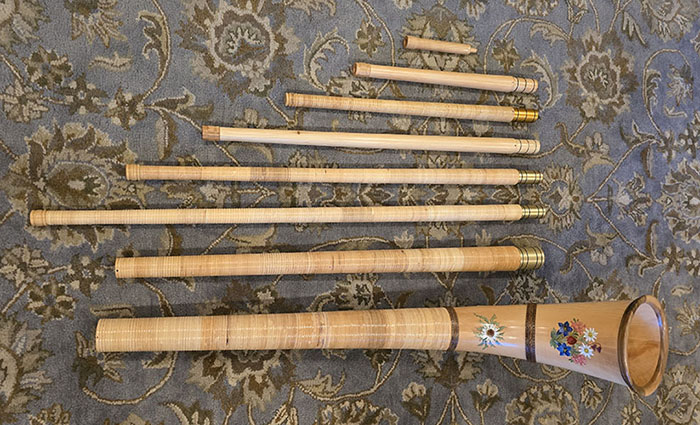
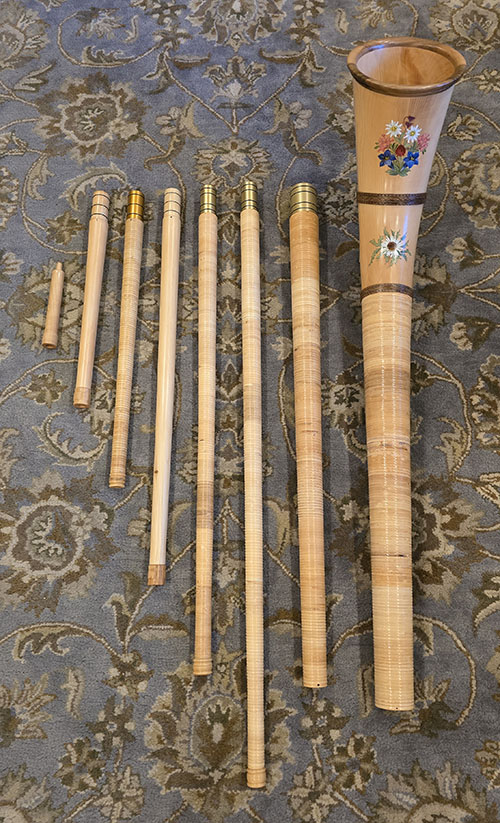
My current set of alphorn tubes is shown below. From left to right:
- 1/2 tone adapter for F# to F, made by Gary
- A tube, made by Gary from Engelmann Spruce
- A-Flat tube, made by Walter Bachmann
- G tube, made by Gary from Gorman Elite ESLP (Engelmann Spruce/Logpole Pine)
- F-Sharp tube, made by Walter Bachmann (included in original alphorn purchase)
- F tube, made by Walter Bachmann (included in original alphorn purchase)
- Middle tube, used in all tunings, connects the bell section to the hand tubes.
- Bell section
Videos of Alphorn Tuning Changes
Virtuoso Swiss alphornist Lisa Stoll frequently switches between F and F# tuning using a 1/2 tone adapter with wonderful musical effect. Here is one of the best examples:
- Lisa Stoll & Kapelle Carlo Brunner: Zungenbrecher | Potzmusig | SRF
YouTube: https://www.youtube.com/watch?v=E8Y2GzjqMVU- Lisa begins in F tuning — you can see her holding the short adapter inserted into the F# hand tube.
0:51—0:55. Lisa switches from F to F# by pulling out the adapter. At this point you can see her holding the adapter. - 1:33. Here is a close-up view of the adapter
- 1:46–1:50. Lisa inserts the adapter back into the F# horn to play in F.
- 2:37—2:41. Lisa once again pulls out the adapter and plays in F# through the end of the piece.
Here you can also see how see switches her alphorn mouthpiece from one tube to the other!
- Lisa begins in F tuning — you can see her holding the short adapter inserted into the F# hand tube.
- Lisa often plays "Tanz der Kühe" several times through in F, then switches to F# (pulls out the adapter) at the end. Example: "Tanz der Kühe" from her album "Alphorn Liebe":
YouTube: https://www.youtube.com/watch?v=mblkZ1shdik
The switch from F to F# begins at time stamp 2:36.
For a summary of how I built the G and A tuning tubes for the Seattle Opera performances, click here.
For a general introduction to my experience with wood working and wood turning, click here.
For some of my more playful attempts at building natural horns from various materials in various tunings, click here.