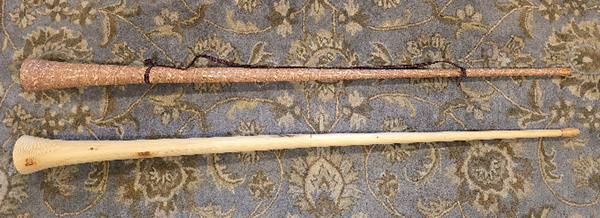
Making a Lur
Links to Sound Samples:
Lur 2: Canadian Spruce, unwrapped
Lur 3: Canadian Spruce, wrapped in Birch Bark provided by Bloedel Reserve
In November 2024 I purchased a Swedish lur (in B-flat) built in 1980. Here is a separate web page about that lur: https://alphorns.com/lur.html
As I began making alphorn tuning tubes for the Seattle Opera's performance of Richard Strauss's opera Daphne, I developed skills that applied to making a lur.
Initially I had difficulty finding spruce wood, the ideal wood for making lurs and alphorns. I decided to begin with sections of Douglas Fir from a local lumber store. I used the basic design of the Swedish B-flat lur to begin working on a lur in F, longer than the lur in B-flat, half the length of my alphorn in F. The lur in F should play an octave higher than my alphorn in F, but still access the same harmonic series.
Lur in F: From Douglas Fir
Below: First stages of laying out and trimming the three blocks. Each block needed to be in two long halves for gouging the bore.


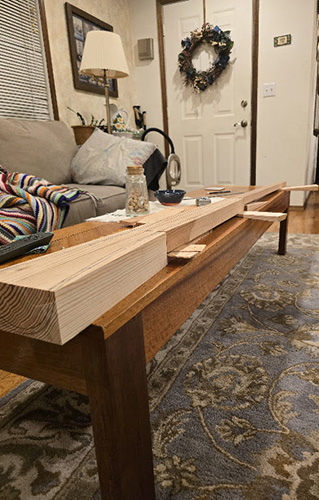
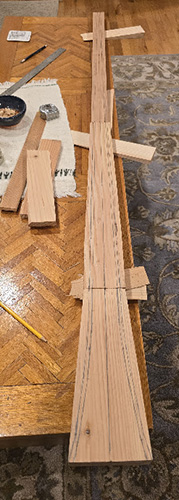
I began working on the bell part:


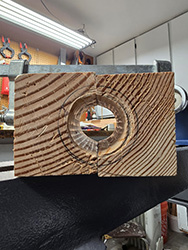


I made a middle part and a narrower part leading to the mouthpiece, then assembled and glued all three parts together. I made a few mistakes on the exterior tube work, and, since I had no source of birch bark to cover the lur in the traditional way, I bought some inexpensive grain-patterned duct tape :)
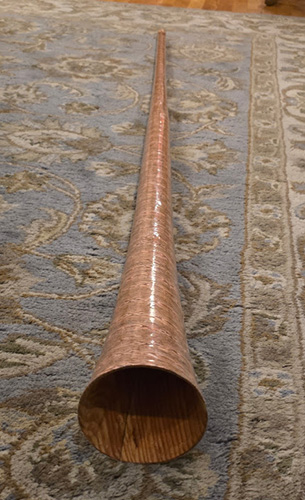
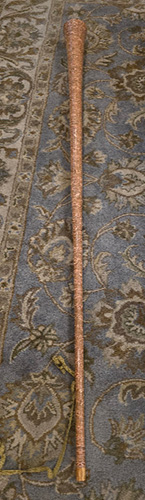
Here it hangs on the wall under my Swedish B-flat lur:

Sound Samples linked below.
Lur in F: From Spruce
I found spruce boards at a different local lumber store. I decided to try making a 2-piece lur. I used a similar conical formula as the lur in Douglas Fir, but I made the bell on this one a bit wider. I am happy with the way it turned out. I have found a local source for birch bark, but this wood with its array of knots looked too nice to cover. So I finished it with 4 thin layers of Birchwood-Casey Tru-Oil Gun Stock finish, buffing lightly between coasts with Scotch-Brite pads, then used Renaissance Micro-Crystalline Wax Polish for the last step.
I have begun making a third lur from spruce. That one I will wrap in birch bark.


Made a stand for the 2 pieces:


Sound Samples
For the sound samples I transcribed a lur melody (#3) from the YouTube recordings by Eilif Gundersen.
His lurs are tuned to G. My lurs are tuned to F (a whole step lower).

YouTube Link: https://www.youtube.com/watch?v=8XOvnuEJBLA
Melody Nr. 3 begins about 1:33 into the video.
Lur 1: Douglas Fir Lur in F
Click on the image:

Lur 2: Spruce Lur in F
Click on the image:

Lur 3: Spruce Lur in F, Wrapped in Birch Bark
With many thanks to the Bloedel Reserve on Bainbridge Island for gathering birch bark and providing it to me for wrapping this lur in the more authentic Scandinavian custom:
Rebecca Edgren, Development Specialist, Andy Moss, Gardens East Manager, and Lee Cross, Social Media Coordinator.
Norwegian Lur Melody — Click on the image:

Images of birch bark wrapped lur:


Comparison of my 3 F Lurs:
Left: Douglas Fir, wrapped in tape
Center: Canadian Spurce, unwrapped
Right: Canadian Spurce, wrapped in Birch Bark.
[Hanging on the wall: Lur in B-Flat from Sweden, made in 1980]

Visit to Bloedel Reserve: Thursday, March 26, 2026
Lur Playing behind the Main Residence (click on the image):


People who live on the point of land where the red circle is could hear the lur playing :)

Andy Moss

Rebecca Edgren and Andy Moss

Back of the Main Residence

View from the terrace at the back of the Main Residence

Himalayan White Birch Trees (photo taken Dec 3, 2025)

Birch Bark (photo taken Dec 3, 2025)